Monday, January 31, 2011

Evening Grosbeaks

Evening Grosbeaks at Karl's "rusty nail" feeder. Yvonne Koenig/Karl Madsen photo
While some of our friends in northern Saskatchewan shudder when a noisy horde of Evening Grosbeaks descends on their feeders, our son and his wife are delighted to see them at their Okangan feeders. I think it's all part of the "familiarity breeds contempt" business. They come down from the mountains to search for lunch in the valley when their regular food sources are running low and so are a rare treat for Karl and Yvonne.

Thus far in the five years we've been in Naicam, we have not had Evening Grosbeaks visit our feeders although we have had both Rose-breasted and Pine Grosbeaks.

Did you know that an Evening Grosbeak is actually a finch and that they are named Grosbeak (i.e. big beak) for their thick, short, conical bills needed for cracking seeds? And that the Evenings have the largest (is that grossest) beak of all grosbeaks?

Several years ago, Yvonne was at her computer when a grosbeak crashed into the window right in front of her and dropped to the deck. She phoned me to ask what she should do, should she should take it to the vet. I advised her to put it somewhere safe from cats or other predators - like a box or an upturned bucket - and let it recover on its own.

I'd learned about the amazing recuperative power of birds the hard way. Middle daughter Kristin, then seven or eight,was going out the door on her way to school when she discovered a dead bird on the deck. It had obviously collided with the window. She was in tears watching me pick it up by one toe and deposit it gingerly in the garbage can. After school she brought a clutch of friends home with her to view the dead bird. When she opened the lid, the magically recovered bird flew off and I became known as the mother who throws birds in the garbage.

And yes, Yvonne's first bird rescue was successful. After resting and recuperating, the grosbeak flew off to join its buddies.

P.S. So this is Groundhog Day! Six more weeks of winter? If that's all, we'll be dancing in the street!

Friday, January 28, 2011

What are you eating?

Orange-variant House Finch on top of feeder made entirely of recycled wood. Margaret Madsen photo
My last blog was about a bird house recycled from a rotten log. Today we have a feeder built entirely of recycled wood by our son Karl. But actually, it's not the feeder I want to talk about, but that little guy perched up on top. Okay, okay, it's not a great photo. You'll have to trust me when I tell you it's a House Finch and not your regular run-of-the mill red-fronted House Finch but an orange variant.

House Finches are cheerful streaky brown and white sparrow-like little birds with red breasts, foreheads, eyebrows and rumps. The red can range from bright scarlet through shades of red-orange to orange and even yellow. We had yellow variants at our feeder here in Naicam last summer. It was hard to believe they were the same species as the scarlet red birds eating next to them. The variation in color is apparently linked to carotenoid pigments in the fruits the birds eat, according to The Sibley Guide to Bird Life and Behavior.

I learned another interesting tidbit about the domestic life of House Finches from Sibley. The male apparently feeds the female while she is busy incubating the eggs and after the chicks are born, he continues to feed her, regurgitating seeds into her mouth. She then in turn regurgitates seeds into the mouths of her newly-hatched babies. As soon as the chicks are covered with enough downy feathers to keep them warm when she leaves the nest, she joins her mate in bringing food to their growing family.

Another "red" bird that regularly visits our summer feeders is the misnamed Purple Finch. Roger Tory Peterson, author/artist of the famous Peterson Field Guides, described them as "sparrows dipped in raspberry juice." It's the perfect description. Their red has a tinge of blue in it, just like raspberries.

Female House and Purple Finches have no red but both are streaked brown and white. You can tell them apart by checking their heads. The female Purple Finch has a prominent light stripe behind her eye, a dark brown  cheek patch, white jaw stripe and dark broad chin stripe. The female House Finch, on the other hand, has a plain brownish face.

Ah me, life at our feeders at the moment is pretty boring - House Sparrows, Black-capped Chickadees and Redpolls. It was the red on the Redpolls that reminded me of the red finches of summer and inspired today's blog.

I'll be back here again on Monday. I will try to continue to post Monday, Wednesday, Friday. Meanwhile, if you have a bird photo or story you'd like to share, email it to me at rutan212@gmail.com.

Wednesday, January 26, 2011

Birdhouses and a cowboy

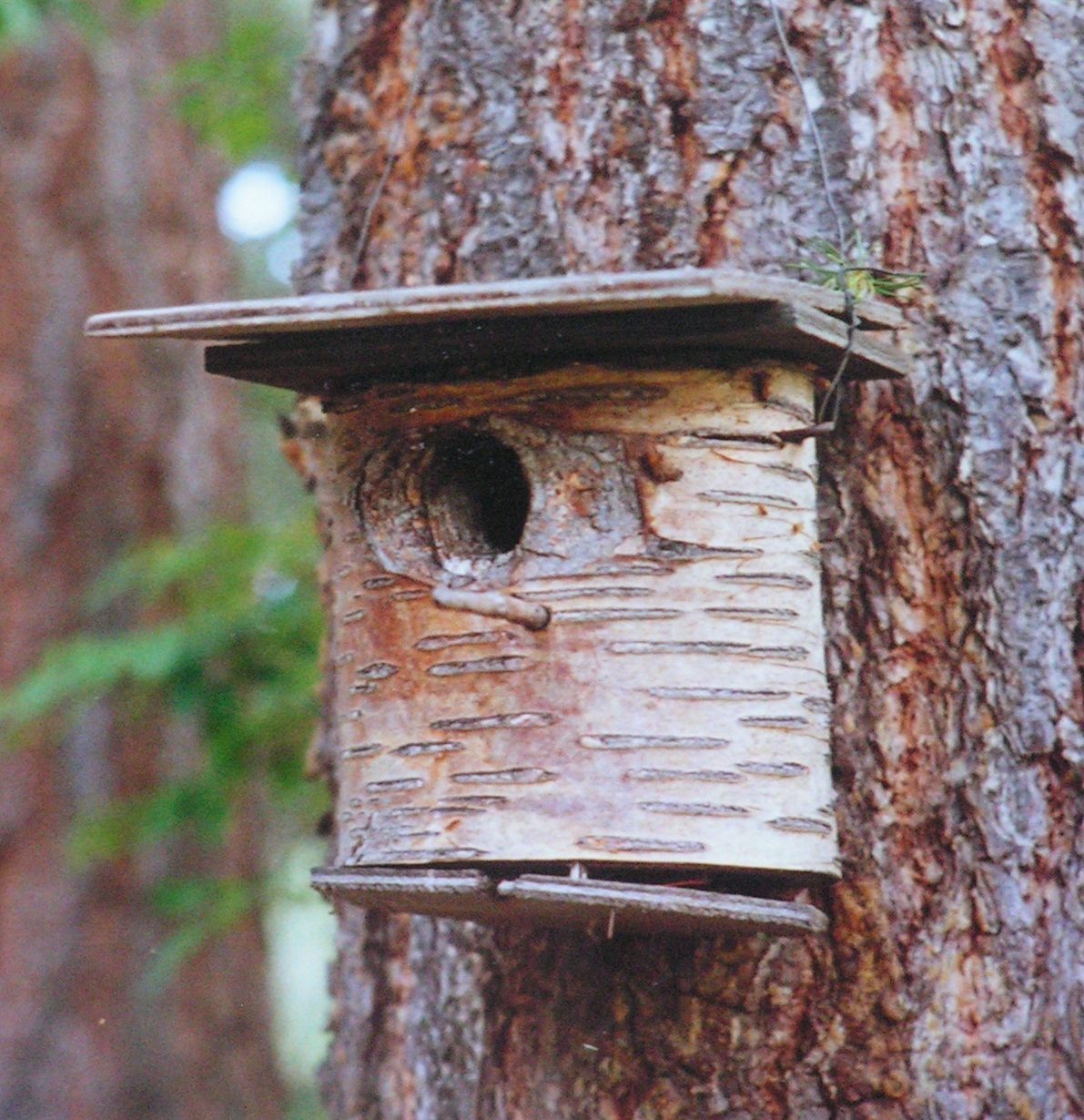
Simple birdhouse made from a hollowed log. Margaret Madsen photo
There's no better tonic for a cold, blustery day than to cuddle inside with a seed catalogue or gardening magazine and dream of summer gardens. It seems that birdhouses are the current decorative item of choice in all the gardens featured in magazines. There are birdhouses that look like churches or log cabins or alpine lodges or miniature versions of the gardener's home. They come in all shapes and sizes and every color of the rainbow to coordinate or contrast with the flowers growing near. In fact, it's like birdhouses have become the toss cushions in the garden "room".

Don't get me wrong. I love birdhouses regardless of their shape or color. As long as they actually welcome birds - like the one in today's photo. It was taken 15-20 years ago while I was still working for a newspaper - you can tell by the bark on the Ponderosa pine that it was in BC.

I'd gone to interview an old cowboy who in his late-70s was retiring as head herdsman on a local ranch, a job he'd had for more than 50 years. He looked exactly like one would expect an old cowboy to look - whip lean, leathery as an old boot, slightly bow-legged. He was soft-spoken and rather shy, so I was grateful his wife was there to prod him along and fill in the blanks.

They told me about the glory days of the 1950s when the herd he looked after was the most celebrated in Canada, sweeping top honors at the biggest Canadian cattle show, the Toronto Royal Winter Fair.

So how did you get cattle from the central Okanagan all the way across the country to Toronto in the days before Rogers Pass or the Trans-Canada highway or the mega cattle-hauling trucks of today? By rail, that's how. This was still a journey of four or five days which meant the cattle couldn't travel on their own; someone had to feed and water them - Harold and another ranch worker. And their wives.

They arranged for a boxcar to be spotted at the siding well in advance of departure date. This allowed them to have stalls built to keep the animals sorted, the hay and other feed and supplies safe. Above the stalls, they built a platform for the human caregivers to sleep, cook, eat and while away the miles. And as they told their story, it sounded like a great adventure, not a horrendous hardship.

As I was getting ready to leave, I noticed the rustic birdhouses in their yard. Harold explained that he made them from hollow logs he picked up in the bush when checking cattle. Small diameter logs like the one here, which was home to a tree swallow that year, were given small openings and closed top and bottom with pieces of recycled wood. Larger logs made homes for bigger birds. He'd put one of these big ones up back in the bush where he'd originally found the log and it had attracted a nesting owl.

Monday, January 24, 2011

Happy birthday, Evelyn

Female Rufous Hummingbird. Margaret Madsen photo.
Whenever my sister Evelyn's birthday rolls around, I cheer and feel like dancing in the street. It's so wonderful to be able to say, "Happy birthday, Evelyn!"

Ten years ago when a biopsy had just confirmed that she had cancer, we sat with coffee mugs at her dining room table in Humboldt, talking and weeping.

"I'm going to fight like anything to beat this," she said, reaching for my hands. "But if I can't, I'm okay with that, too, but I need to know you're okay with  it."

"I don't want to lose  you now. Not so soon after Joyce." Our sister next in line after Evelyn had died two years earlier in a car accident.

"I miss her too," Evelyn said.

We gripped hands tightly and wept, overwhelmed by thoughts of death and the waste of lives cut short. Our sister Joyce had had a turbulent and troubled life, and her method of relaxation and renewal had always been to walk on her own with a pair of binoculars around her neck, seeking solace in observing the wild creatures. In her latter years,she loved to roam the hills above Penticton where she lived.

When our children were young, she brought them unusual gifts like a huge, perfect abandoned wasp nest on a tree trunk, and another time, a plaster casting of a cougar paw print, and the first bird feeder we'd ever owned. She always had stories of birds she had seen on her walks, though she kept no lists and scoffed at those birders who worried about "life lists."

She was a quiet person, but at the same time, exotic and unconsciously flamboyant. I told Evelyn about the last time she and her husband had spent Christmas with us when their daughter was little. She had worn a brilliant scarlet poinsettia above her ear, very striking against her hair.

As Evelyn and I wiped our tears, movement in the still-leafless lilac bush outside the window caught our attention. The tiniest little olive green bird was hopping from branch to branch, poking at the leaf buds and flicking its short tail. We didn't know what it was - white eye ring, dark wings with white bars, light greenish yellow below, dark short tail.

And suddenly the little bird tilted its head down and we had a perfect view of a vivid red rectangle running front to back on top of its head. Evelyn and I both gasped. The red crown was so unexpectedly flamboyant on the rather drab wee bird. And the red was the same shade as the poinsettia Joyce had worn at the Christmas dinner years earlier.

We had just seen our first Ruby-crowned Kinglet in full breeding splendor. According to the guide books, it's unusual to be able to see the red crown because the male flaunts it only during breeding season and the birds are usually high in the tree canopy. We were very fortunate.

We felt strangely comforted and reassured, as though God had spoken or an angel had visited us.

Happy birthday, Evelyn.

Friday, January 21, 2011

Roman bath for Naicam birds

This is the revamped birdbath in my Naicam yard. John Madsen photo
Are you longing for spring, too, for the song of a meadowlark or the sight of flotilla of ducklings bobbing around their mamma, or the flash or orange and black that signals the return of the oriole?

It was about this time last year that my sister Linda began talking about a garden craft project, something we could make for our yards before yardwork season arrived. Over the next few weeks - and then the next few months - we traded ideas back and forth over the phone. My baby sister Linda is the Queen of Crafts. She came up with the winning idea - birdbaths tiled with leftover pieces of glass from her stained glass projects.

She and Howard have a waterfall under construction in the circular garden bordered by their driveway. She said envisioned water falling over the stones and splashing into a birdbath fashioned from a gold panning bowl.

I loved the birdbath idea, but instead of the pan, could I not do something with my old metal birdbath that was suffering the ravages of time? The fake verdigris finish had worn off the bowl and it was down to black metal that attracted so much heat from the sun that in just minutes cool tap water was turned into a sauna.

As soon as Evelyn was back from Arizona, we had a sisters' day on Linda's deck on an unusually warm April day, and we tiled, gossiped and sipped wine. When I started, I envisioned undulating shades of blue and green creating the look of water in the bowl, and to this end I first affixed a wavy line of dark green across the diameter. We used silicone outdoor tile adhesive. After the first disciplined line went down, all hell broke loose and I just had fun adding pieces of whatever color called to me. Like the orange. Maybe it would attract birds flying high overhead. Like the white and light colors that I hoped would help keep the water cooler. Like the dollar store glass pebbles that might look like bubbles. It was definitely a fun project, and fun mostly because I was working side by side with my sisters, busy on their own tile masterpieces.

By the way, the birds last summer seemed to love the recycled Roman bath.

Wednesday, January 19, 2011

Shivering sparrow in a gray felt hat

Peek-a-boo House Sparrow. Margaret Madsen photo
From inside my warm kitchen I look out on the cold silver and blue morning, and yes, that is blue snow, not blue sky, beyond the feeder. It's minus 28 outside and according to the television, Jan 17, when I took this photo, is the most depressing day of the year. Yikes! When will spring come?

You can tell I'm suffering from cabin fever when a pesky House Sparrow starts to look appealing to me. Isn't he cute? He looks like he's playing peek-a-boo. House sparrows are incredibly difficult for me to photograph. The moment they notice the slightest movement in the window they take off in frantic flight. There were half a dozen on the feeder when I began to depress the camera "button" and just this one left when the shutter actually clicked. There was a dozen or so Common Redpolls among the hungry horde of sparrows on the ground under the feeders this morning. They stayed calmly collecting their breakfast while the sparrows leapt nervously to the spruce tree.

Why do you suppose sparrows are so jittery, chickadees so friendly and red polls so indifferent to people?

I think the House Sparrow must have been the first bird I learned to recognize. They were ever-present at Rutan, the elevator siding south of Meacham where I grew up. Because I've always known a Passer domesticus on sight, I never closely examined one until about 10 years ago when I was giving grandson Ian, then 6 or 7, a lesson on identifying birds.

"Describe the bird outside the window," I instructed, handing him the binoculars.

"It's brown and black," he said.

"What else?"

"It's stomach is white. And it's black and brown on its wings and there's white stripes. And it's black under its chin and up to his eyes. And then it's brown. And it's gray on top of its head"

"Gray on its head?"

"Yes, Grandma. Gray."

"Let me see." I took the binoculars and looked. He was right. I knew perfectly well what a sparrow looked like, but I had never looked closely enough to see the distinct gray, like a flat felt cap, on top of his head!

And that just goes to show how we can look without seeing, how we can see what we think is there, and how we can learn so much from children.

Monday, January 17, 2011

Black-crowned Night-Heron

Black-crowned Night Heron in Hawaii. John Madsen photo
When we arrived at our hotel in Kona on the Big Island of Hawaii a few years ago, we were startled to see someone we recognized from Saskatchewan - a Black-crowned Night-Heron basking on a rock in the lobby pool. Prior to this, the last night-heron I had seen was the previous summer, slowly beating its way just above the water, following the creek on the ninth hole of Naicam Golf Course.

At first we didn't notice that the bird only had one foot. According to a hotel worker, its foot was probably snapped off by a fish. And this wasn't a winter visitor like us. It lives there year round and is called Aukuu in Hawaiian.

Black-crowned Night-Herons are the most widespread herons in the world found on all the continents except Antarctica. They are about the same size as crows and their bill is much shorter than that of a Great-Blue Heron. They don't stab their prey; they catch it. They also nest in colonies, in trees, bushes or cattails.

The first colony of Night-Herons John and I saw was at the Pamela Wallin Wetlands, just south and west of Wadena. It was surprising to see so many slump shouldered birds in the trees but they were also on the ground by the edge of the creek and seemed to be catching something to eat - maybe frogs? Apparently they prefer to hunt at dusk or at night - hence their name - and this adaptation allows them to share the same foraging territory as Great-Blue Herons, for example, which hunt during the day. It was afternoon when we saw them, so does this mean that they are night-hunters only if there are other herons around?

Female Night-Herons must be blessed with a surfeit of maternal instinct because they don't mind looking after someone else's babies, too. Or is it the opposite - so little maternal instinct that they cannot tell strange babies from their own? It's a mystery.

The one-footed night-heron in the photo did, in a sense, solve an old mystery for me. Some 60 or so years ago, when my siblings and I were trudging 2+ miles home from the one-room country school house we attended, we came upon a meadowlark hanging upside down with one foot impaled on a barb on the fence. We thought it was dead but, when we got close, it struggled mightily to free itself. We could see the foot was nearly severed from the leg. While one cupped the bird to keep it from causing further damage, another tried to free the foot but it was fused to the barb and could not be budged.

That's when a pair of blunt-nosed scissors came out of a pencil case, and with one snip, the foot was severed and the bird was set free. Immediately it flew some distance out into the field and disappeared from view. But could a bird survive with only one foot? The night-heron in Hawaii answered that.